Search for snow removal companies near me and the results use "removal", "plowing" and "clearing" as if they were one service. On a quote they are not. Plowing, clearing, relocation, hauling and salting are five separate operations, and a proposal can bundle any mix of them under any name. This guide defines each term, shows what residential and commercial providers sell under each one, and ends with a checklist for sorting the results.
Plowing: pushing snow with a blade
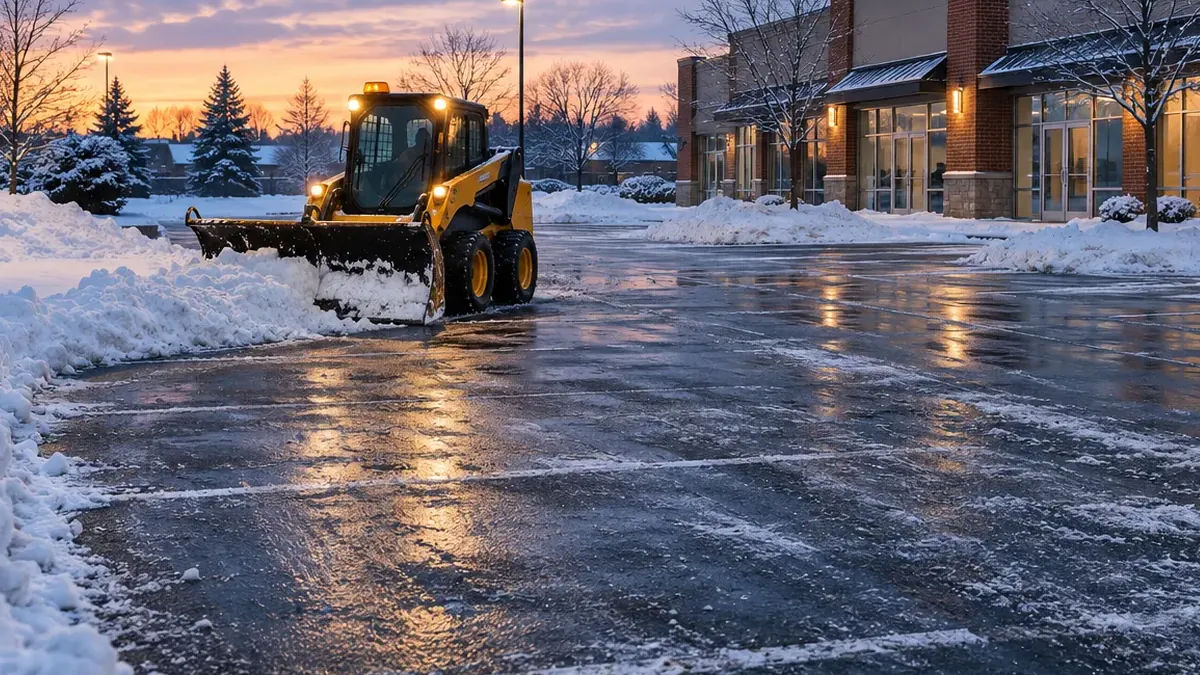
Plowing means pushing snow across a surface with a blade on a truck, tractor or compact loader. The snow is not picked up. It is moved to the edge of the surface and left in a bank.
Plowing suits wide, open surfaces: driveways, parking lots, drive aisles. It is the main operation on most driveways and almost every commercial lot.
A blade leaves a ridge where each pass ends, cannot work steps or narrow walkways, and stops short of garage doors, walls and parked cars. Whether that finishing work is included is the first thing to confirm in a quote.
A listing that says only "plowing" means "we move snow on the large surfaces". It says nothing yet about walkways, where the snow ends up, or ice.
Clearing, shovelling and blowing: walkways and tight spaces
Clearing is the general word for getting snow off a surface by whatever method fits: hand shovelling, snow blowers and small push machines. It covers everything a blade cannot, including walkways, steps, ramps, entrances and the windrow the municipal plow leaves across the end of a driveway.
Clearing is slower per square metre than plowing. A visit that covers the driveway and apron, the walkway to the front door and the windrow at the entrance is a plow-plus-clearing job, not a plow-only job.
Municipal sidewalk frontage is usually a separate clearing line. Confirm whether it is included, and read the city's current winter maintenance guidance before you decide whether to add it.
Plow-only operators and walkway-only snow clearing companies both exist. The proposal should say which surfaces get which treatment.
Relocation, stacking and hauling: moving snow or removing it
Everything above moves snow to the edge of a surface. What happens next decides whether "removal" is the right word.
Stacking is piling plowed snow in an agreed spot on the property: the lawn beside a driveway, or a marked corner of a lot. Relocation is moving it a second time within the site, usually with a loader, once piles have grown into sightlines, parking spaces or fire routes. Both keep the snow on the property.
Hauling is true removal: snow is loaded into trucks and taken off site, with its own equipment and its own line on a quote. Most residential properties have room to stack all season; on commercial sites hauling becomes relevant when stacking space runs out.
Salting and de-icing: a separate service
Salting applies de-icing material to melt ice or to stop fresh snow bonding to the pavement. De-icing and ice management describe the same work more broadly, including walkways and steps during freezing rain or after a thaw-refreeze cycle, when no plowable snow has fallen.
It is a separate service because it responds to different weather. A plow visit is triggered by accumulation; a salting visit may be needed on a morning with no new snow at all. That is why MapleCore quotes salting as a separate line unless the package includes it.
The two residential packages show the split. Basic Snow Removal is "Snow removal only (salting not included)". Deluxe Snow & Ice Removal has "Snow clearing and salting included" and "Coverage for snow, freezing rain, ice and light snowfall events, subject to contract terms". The line-by-line comparison is in Basic vs. Deluxe snow removal.
What snow removal companies near me actually sell
Residential and commercial providers use the same five words for different bundles. The table shows what each term usually covers; a specific proposal can differ.
| Term | Residential (driveway contract) | Commercial (site contract) |
|---|---|---|
| Plowing | Driveway and apron | Parking lot and drive aisles, with accessible spaces and fire routes first |
| Clearing | Walkway to the front door, the windrow at the entrance, optional municipal sidewalk frontage | Walkways, entrances, steps and ramps |
| Stacking and relocation | Snow pushed to the sides of the driveway and left on the property | Agreed stacking zones, with relocation within the site as piles grow |
| Hauling | Rarely offered | Optional when stacking space runs out |
| Salting and de-icing | Optional; a separate line unless the package includes it | Salting and ice management, often with product and quantity logged per application |
MapleCore's residential and commercial scopes are on the snow removal page and the commercial snow removal page; the commercial one includes event logs with time stamps and photos and a certificate of insurance with every agreement.
How to read a quote line by line
Read a proposal for four things.
- Surfaces, each named: driveway, apron, windrow, walkway, steps and sidewalk frontage on a house; lot, fire routes, accessible spaces, entrances and ramps on a site. An unnamed surface is not in scope.
- The verb beside each surface. "Plowed", "cleared" and "salted" are different commitments. A quote that says "driveway cleared" and is silent on the walkway is a plow-only quote with a friendlier word.
- The trigger and the response window. Basic Snow Removal, for example, states "Service begins at 5 cm of accumulated snowfall" and "Target completion within 8 hours after qualifying snowfall ends, subject to contract conditions". Lower triggers than 5 cm are available at a higher seasonal rate.
- Where the snow goes and how ice is handled: a stacking location, whether relocation and hauling are included or optional, and whether salting is included, separate or absent.
Term and billing sit underneath. MapleCore's seasonal contracts, for example, run November 15 to April 15 and are invoiced in monthly instalments. The factors that move a seasonal price are in how much seasonal snow removal costs in the GTA.
A checklist for vetting snow plowing services near me
Once you know the vocabulary, ask each company for six things in writing before you sign.
- Written scope by surface. Every surface named, with the operation that applies to it. A verbal description is not a scope.
- Triggers and response terms. The accumulation trigger, the response window, how large storms and return visits are handled, and whether daytime passes during ongoing storms are specified on a commercial site.
- Insurance. A current certificate of insurance before the first event. MapleCore includes one with every commercial agreement.
- Logging. Time-stamped visit logs on a residential contract; event logs with time stamps and photos, plus product and quantity per salting application, on a commercial one.
- Equipment. What is assigned to your property, whether it fits the surfaces, and the backup plan for breakdowns.
- Communication. Who you call during a storm, how dispatch is decided (monitored weather data, not your phone call), and how a missed visit is raised.
A company that answers all six in writing is selling a defined service. For a commercial site, the operational playbook is in how to prepare your commercial property for snow and ice. To get a proposal written to that standard, request a free winter quote; it creates no obligation, and seasonal contract requests for winter 2026–2027 include the 10% discount in the written proposal.