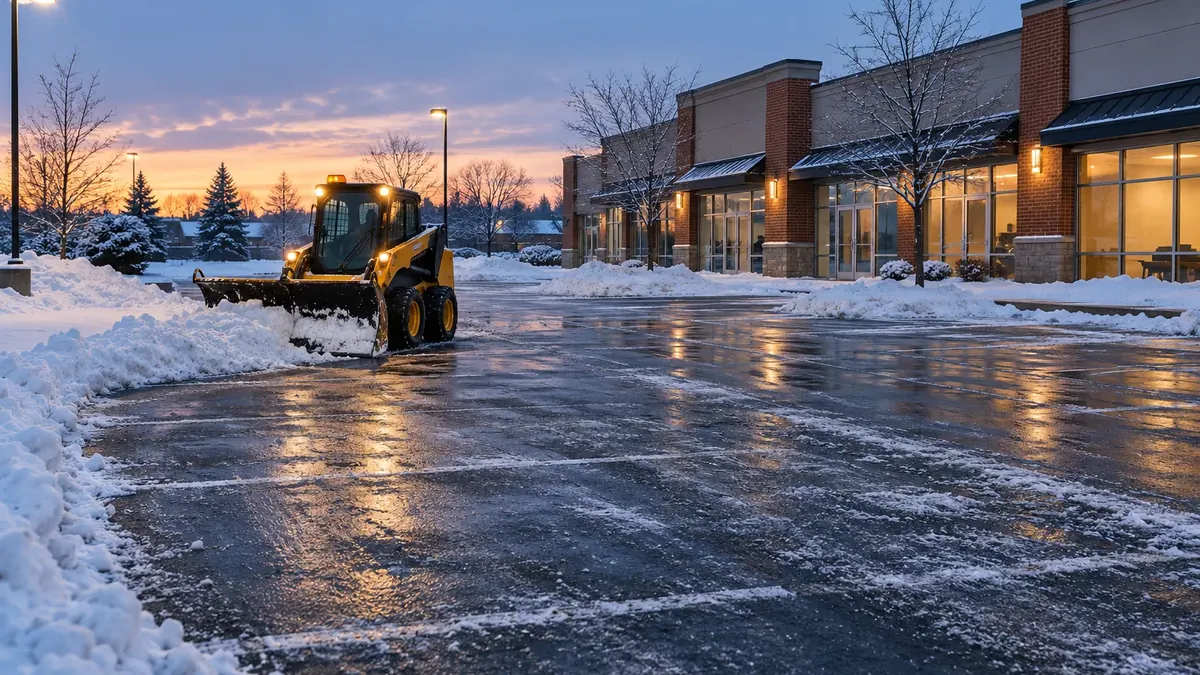

You are signing off on a winter plan for a site where tenants, deliveries and visitors expect to get in after a storm. The commercial snow clearing plan that holds up is written down in October: every surface named and ranked, trigger and response terms agreed, ice as its own line, and a protocol for who calls whom and what gets logged. This playbook covers those steps in order for any west or central GTA site, with the Mississauga guide as a local companion.
Define commercial snow clearing scope by surface
A scope that says "parking lot and walkways" is not a scope. List every surface the contract covers, grouped by how it gets cleared.
- Vehicle surfaces: parking rows, drive aisles, fire routes, loading areas, garage ramps and the entrance apron where the municipal plow leaves its windrow.
- Pedestrian surfaces: sidewalk frontage, internal walkways, steps, ramps, landings and the strips between parking rows that people cut across.
- Transitions: curb cuts, door thresholds, the canopy drip line and the first metres of every ramp, where compacted snow ices first.
- Exclusions: what is left out (roofs, canopies, bike racks) and what the property handles itself.
Record the method for each surface and where its snow goes. On tight sites, relocation within the site comes first, with hauling off site as an optional line once stacking space runs out.
The commercial snow removal page lists the full scope; priority zones, stacking corners and tenant hours are worked through in the commercial snow removal in Mississauga guide.
Build the priority tiers
Ranking decides where the crew starts at 3 am and what "done" means for each surface. Three tiers cover most sites.
| Tier | Surfaces | Target |
|---|---|---|
| 1 | Accessible spaces and their route to the door, main entrances, fire routes, hydrants | Before the earliest tenant opens or the first shift arrives |
| 2 | Loading areas, remaining drive aisles, main parking rows, internal walkways | Within the response window agreed in the contract |
| 3 | Overflow parking, rear areas, windrows and stacked corners | After the event, once Tiers 1 and 2 are holding |
Write the tier beside each surface with the time of day that matters: earliest opening, first delivery, shift change. The same order governs return passes in a long storm.
Fitting tiers to mixed tenant hours is covered in the commercial snow removal in Mississauga guide.
Agree the trigger and response terms
Three terms do most of the work in a commercial snow clearing contract, and each needs a definition.
- Accumulation trigger. The snow depth, in centimetres, that dispatches a visit. A lower trigger means more dispatches over the season, which is one of the factors a provider prices.
- Response window. When the clock starts (usually when qualifying snowfall ends) and how long the crew has to complete each tier. Ask how it applies on day three of a long storm.
- Daytime passes. Whether the crew returns during business hours while a storm continues, and on which surfaces; without this term, Tier 1 fills in until the evening pass.
Agree how dispatch is decided too. MapleCore dispatches based on monitored weather data reviewed by the operations team, with daytime passes during ongoing storms where the contract specifies them. Ask any provider who makes the call.
Plan ice management as a separate line
Snow follows a storm. Ice turns up days later: on clear nights after a thaw, under drip lines and downspouts, on shaded ramps. The GTA sees freezing rain and thaw-refreeze cycles most winters. Four decisions follow; the service scope itself is on the salting and ice management page.
- Materials. Rock salt is the standard de-icer for asphalt but slows as pavement temperatures fall well below freezing, which is where treated salt and chloride blends come in. Sand or grit adds traction without melting.
- Sensitive surfaces. New concrete, decorative pavers and precast steps can scale or stain under heavy salt. Flag them, specify a gentler product or grit, and keep salt-laden piles off beds and turf edges.
- Pre-treatment. Product applied before freezing rain or snowfall limits how firmly ice bonds to the pavement. Decide whether it is in scope and on which surfaces, since it changes the number of applications.
- Logging. Every application recorded with product, quantity and surfaces treated, so invoices reconcile and repeat trouble spots show up.
Salting is quoted as a separate line unless a package includes it. MapleCore's salting and ice management service logs product and quantity per application.
Agree the escalation protocol and what gets documented
Write the protocol as one page, not a number in someone's phone.
- Contacts. One dispatch contact at the provider, answered during events, and one decision-maker at the property who can approve extras like hauling.
- Reporting path. Tenants report to property management, which escalates to the provider; the crew does not take instructions in the lot.
- Severity. A blocked accessible space or fire route is immediate; a stacked corner waits for the next pass.
- Closure. An escalation names the location, surface and time, with a photo; the provider closes it with a time-stamped photo in the event log.
By April, the site file should hold:
- The signed agreement: surface list, tiers, trigger and response terms, salting list.
- The marked site plan and pre-season condition photos of pavement and curbs.
- Event logs with time stamps and photos for every visit, salting logs with product and quantity, and invoices reconciled against both.
- The certificate of insurance, which MapleCore includes with every commercial agreement; ask any provider for theirs.
Brief tenants and staff, then stage the site
The contract covers the crew's work. Your own people need four things in writing:
- Who to call: property management, not the driver in the lot.
- Where not to park during and after events, and what happens to vehicles left overnight.
- What the property handles in-house: entrance mats, inside the doors, salt touch-ups between visits, and where the salt bin lives.
- The tier their surface sits in, so a Tier 2 tenant knows the lot comes after the entrances.
Staging is the other half: confirm after-hours access and who answers when a code fails at night, agree where equipment stages and where the first pile starts, mark sensitive surfaces and curb lines on the ground, and walk the site with the crew lead before November 15.
Review after the first event
The first qualifying snowfall tests the plan. Within a few days, open the event log and answer five questions.
- Were Tier 1 surfaces complete by the time you set?
- Was any surface missed, and is it on the list? A miss is usually a scope gap.
- Where did the piles land, and did meltwater cross a walkway the next afternoon?
- Where did ice form afterwards, and are those spots on the salting list?
- Did the logs arrive, and do they match what tenants saw?
Adjust the plan in writing and repeat after the first freezing rain.
For winter 2026–2027, MapleCore's commercial agreements define triggers and response windows per contract and include event logs with time stamps and photos. Request a free quote for one site or a portfolio with consolidated or per-site invoicing. Seasonal contracts run November 15 to April 15, are invoiced in monthly instalments, and the proposal includes the 10% seasonal contract discount.