
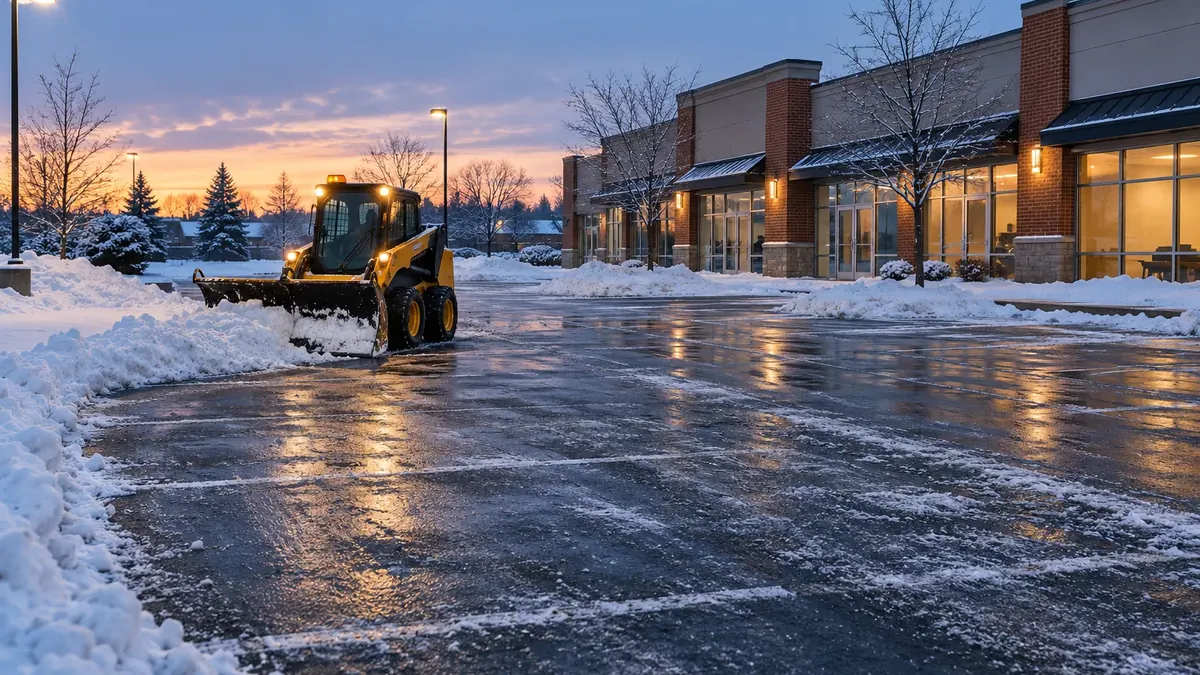
You manage a site where tenants open at different hours, the lot has one corner that can take snow, and the first call after a storm comes to you. Commercial snow removal in Mississauga works when the site plan, the service schedule and the paper trail are settled before November 15 rather than worked out during the first event.
Start with a site plan and priority zones
Go through a site plan (a survey, an aerial image or a marked-up leasing plan) with the provider before the season.
The zones that go first on almost every commercial site:
- Main entrances and vestibule aprons, including the step or ramp at each door.
- Accessible parking spaces and the route from them to the door.
- Fire routes and hydrant access, kept open at full width rather than narrowed by a windrow.
- Loading docks, dock aprons and the turning area a trailer needs to back in.
- Garbage and recycling enclosures, including the gate swing and the pad the truck lifts from.
Second tier is the remaining drive aisles and parking rows; third is overflow parking and rear areas nobody uses until the lot fills.
The GTA-wide version of this exercise, including how to agree on accumulation triggers and response windows, is in how to prepare your commercial property for snow and ice.
Pedestrian routes and sidewalks
People walk the shortest line between a parked car and a door, not the line on the drawing. Walk the site at opening time once this fall and note where people actually go; those are the routes to clear first.
List each pedestrian surface separately in the scope: municipal sidewalk frontage, internal walkways between buildings, steps, ramps, transit stop pads, and the strip between parking rows where people cross. A scope that says "walkways" without naming them leaves room for argument in February.
Commercial snow clearing on sidewalks uses different equipment than the lot, often on a separate pass, so ask whether it is dispatched with the plow or follows it. Mississauga publishes the city's current winter maintenance guidance for property owners; read it before you finalize the sidewalk line.
Parking lot plowing: where the snow goes
Before the first event, decide where piles go and draw those locations on the plan.
Good stacking spots sit away from entrances, clear of sightlines at the driveway exits, and off accessible spaces, fire routes and catch basins.
Two or three events with no thaw between them can fill a tight plaza lot's designated corners. The contract should say what happens next: relocation within the site, then hauling off site as an optional line. How storage and optional hauling affect a seasonal quote is covered in what moves a seasonal snow removal quote in the GTA.
Lots that rarely empty, such as medical offices and multi-residential visitor parking, also need a plan for returning to rows blocked by parked cars.
Accessibility across the whole route
An accessible parking space that is cleared while the curb ramp beside it stays buried is not usable. Treat accessibility as one continuous route: the space, the access aisle, the curb ramp, the walkway and the door.
Points to put in writing:
- Snow from the lot is not stacked on accessible spaces, access aisles or curb ramps.
- Ramps and their landings are cleared to full width, not a single shovel-width path.
- Ramps, curb cuts and entrance aprons are on the salting list, since compacted snow on a slope turns to ice first.
The commercial snow removal scope gives priority to accessible spaces and fire routes and includes walkway, entrance, step and ramp clearing. Ask for that priority order in writing.
Documentation worth asking for
Good documentation lets you answer a tenant's question by checking a log instead of calling around, and lets you reconcile invoices against events. Three records matter most:
- Event logs with time stamps and photos. Each visit recorded with arrival and departure times, the surfaces serviced and photos of the result. If a tenant says the dock was not cleared until noon, you can look instead of guess.
- Product and quantity logs for salting. Each application logged with the product and amount, so you can check that salting is applied as agreed.
- Certificate of insurance. MapleCore includes a certificate of insurance with every commercial agreement. Ask any provider for theirs with the proposal and file it with the contract.
Planning commercial snow removal in Mississauga around tenant hours
The city's commercial stock covers very different operating patterns, and the service schedule should follow the tenants.
| Property type | Where you see it | What matters most | What to specify |
|---|---|---|---|
| Plazas and medical offices | Strips along Hurontario, Dundas and Burnhamthorpe | Early openings, lots that rarely empty | Entrances and pedestrian routes done before the earliest tenant opens; daytime passes during storms |
| Industrial and logistics | Meadowvale Business Park, the Dixie and Dundas corridors | Shift changes, trailer movements, dock aprons | Dock aprons and truck routes clear before the first shift; piles kept out of turning radii |
| Offices | Around City Centre | A concentrated morning arrival window | Lot and walkways complete before the arrival peak; parking structure ramps named in scope |
| Multi-residential | Towers and townhouse blocks across the city | Residents moving around the clock, garbage and move-in days | Entrances, visitor parking and the path to the bin room; a cadence for return passes |
Accumulation triggers and response windows are defined per contract. State which zones must be complete by what time of day for each tenant type, and whether you want daytime passes during ongoing storms, which MapleCore includes where the contract specifies them. Dispatch is based on monitored weather data reviewed by the operations team; ask any provider who decides to roll trucks and on what information.
Coverage for a specific address is confirmed with the proposal; the snow removal in Mississauga page covers how routes run across the city.
Communication and escalation
Agree on the chain before the first storm, not during it:
- One contact on each side: a dispatch number that is answered during events, and one person at your end who can make decisions about the site.
- A reporting path that runs through property management. Tenants report to you, and you decide what gets escalated.
- What an escalation contains: the location on the site plan, the surface, the time noticed and a photo where possible.
- How the provider closes the loop: a time-stamped photo of the corrected area added to the event log.
After a major event, go over what was blocked, where the piles went and what needs adjusting.
Proposals from different providers look alike until you ask these questions. If you are comparing options for winter 2026–2027, request a free quote from MapleCore. Seasonal contracts run November 15 to April 15, are invoiced in monthly instalments, and the written proposal includes the 10% seasonal contract discount. Multi-property portfolios can be set up with consolidated or per-site invoicing.